|
Research Article
Utilizing bidirectional Mendelian randomization to uncover the relationship between infectious diseases and primary biliary cholangitis
1 General Surgery, The First Affiliated Hospital of Bengbu Medical University, Bengbu, Anhui, China
2 Department of General Surgery, The First Affiliated Hospital of Jinan University, Guangzhou, Guangdong, China
Address correspondence to:
Lei Zhou
General Surgery, The First Affiliated Hospital of Bengbu Medical University, Bengbu, Anhui,
China
Message to Corresponding Author
Article ID: 100112Z04YY2026
Access full text article on other devices

Access PDF of article on other devices


How to cite this article
Yang Y, Zhao Z, Huo J, Guo K, Zhou L. Utilizing bidirectional Mendelian randomization to uncover the relationship between infectious diseases and primary biliary cholangitis. Int J Hepatobiliary Pancreat Dis 2026;15(2):14–21.ABSTRACT
Aims: To explore the causal relationship between infectious disease pathogen antibodies and primary biliary cholangitis (PBC) using bidirectional Mendelian randomization (MR) and verify whether PBC has a reverse causal effect on the body’s antibody response to infectious pathogens, thereby providing new insights into PBC’s etiology and a theoretical basis for its prevention and treatment.
Methods: Using Mendelian randomization (MR), we analyzed 46 antibodies against 13 infectious agents (exposures) and PBC (outcome), with single nucleotide polymorphisms (SNPs) from Butler-Laporte et al. as instrumental variables; PBC genome-wide association study (GWAS) data were obtained from FinnGen. Generalized summary-data-based Mendelian randomization (GSMR), inverse variance-weighted (IVW), and multiple sensitivity analyses were performed, with statistical significance set at Bonferroni-corrected P < 5.43 × 10⁻⁴, and a False Discovery Rate (FDR) approach was also applied.
Results: Epstein–Barr virus (EBV) EBNA-1 antibodies reduced the risk of PBC (OR [odds ratio] = 0.552, P = 1.002 × 10⁻⁶), while EBV ZEBRA antibodies increased PBC risk (OR = 1.646, P = 7.239 × 10⁻⁵). Nominally significant associations were observed for anti-Merkel cell polyomavirus immunoglobulin G (IgG) (OR = 1.322, P = 5.759 × 10⁻⁴), anti-herpes simplex virus 2 IgG (OR = 1.234, P = 0.029), and Chlamydia trachomatis momp A antibodies (OR = 1.110, P = 0.033) with PBC risk. Reverse MR analysis indicated that PBC may lower the levels of EBV viral capsid antigen (VCA) p18 (OR = 0.960, P = 0.004) and EBNA-1 (OR = 0.966, P = 0.017) antibodies, while potentially increasing others such as human herpesvirus 6 (HHV-6) and Helicobacter pylori.
Conclusion: Epstein–Barr virus plays a dual role in the pathogenesis of PBC, with EBNA-1 antibodies potentially exerting a protective effect and ZEBRA antibodies acting as a risk factor. Other pathogenic microorganisms may also contribute to PBC development, highlighting the complex host–pathogen interactions that require further in-depth study.
Keywords: Causal relationship, Host–pathogen interaction, Infectious disease, Mendelian randomization, Primary biliary cholangitis,
†These authors contributed equally to this work and share first authorship.
Introduction
Primary biliary cholangitis (PBC) is a chronic autoimmune liver disease characterized by the progressive destruction of small intrahepatic bile ducts, which can eventually lead to liver cirrhosis and liver failure [1]. While the precise etiological underpinnings of PBC remain incompletely elucidated, a growing body of evidence points to the combined contribution of genetic predisposition and environmental triggers—with infectious agents emerging as particularly salient environmental factors—in driving the disease’s pathogenesis [2],[3].
The interplay between infectious diseases and autoimmune disorders has long stood as a central focus of translational and clinical research. A multitude of infectious pathogens are known to activate the host immune system, elicit robust inflammatory responses, and potentially trigger de novo autoimmune reactions through well-characterized mechanisms including molecular mimicry, epitope spreading, and bystander activation [4],[5]. For instance, viral infections can alter the antigen-presenting machinery of host cells, leading the immune system to misrecognize self-tissues as foreign pathogens and initiate an aberrant autoimmune attack against native cellular components [4],[5]. In the context of PBC, epidemiological and experimental studies have reported associations between specific infectious agents and disease onset [6],[7],[8]; however, the causal nature of these links has remained ambiguous in traditional observational research, which is inherently prone to confounding variables and reverse causality biases that obscure definitive causal inference [9].
Mendelian randomization (MR) has emerged as a powerful epidemiological tool that leverages genetic variants as instrumental variables to infer causal relationships between exposure factors and clinical outcomes [10],[11]. Rooted in Mendel’s laws of genetic inheritance, MR capitalizes on the random assignment of genetic alleles during gamete formation—a process that is independent of most environmental confounders and behavioral factors—to overcome the key limitations of conventional observational studies [12]. This unique analytical framework thus enables a more rigorous and reliable assessment of potential causal connections between infectious agents and PBC development.
This study was designed and reported in accordance with the Strengthening the Reporting of Observational Studies in Epidemiology using Mendelian Randomization (STROBE-MR) guidelines [13]. Mendelian randomization studies rely on three crucial assumptions regarding instrumental variables—relevance, independence, and exclusion restriction [14]. To explore the causal relationship between infectious pathogens and PBC, we utilized genome-wide association study (GWAS) summary statistics for antibody levels against 13 infectious agents [15] and PBC data from the FinnGen consortium [16],[17], and applied the generalized summary-data-based Mendelian randomization (GSMR) method [18] together with complementary sensitivity analyses implemented in R software packages [19]. We further verified whether PBC has a reverse causal effect on the immune response to infectious pathogens. Through the strict selection of genetic instrumental variables and multiple MR analysis methods, we expect to provide new insights into the etiology of PBC and a theoretical basis for future prevention and treatment strategies.
MATERIALS AND METHODS
Ethical statement
This research strictly adhered to the STROBE-MR guidelines. The study utilized summary statistics from genome-wide association studies (GWAS), each of which had obtained prior ethical approval. The summary statistics used in this study are publicly available for download from the respective official websites. All data were de-identified, freely accessible, and usable without restrictions; consequently, additional ethical clearance from the institutional review board was deemed unnecessary for this investigation.
Study design
In this MR study, we selected antibodies against infectious pathogens as exposure variables and PBC as the outcome variable to investigate whether infectious agents (characterized by their antibody profiles) have a causal effect on PBC. In the subsequent stage, we further explored potential reverse causality by examining whether PBC has a causal influence on the immune response to infectious agents.
Mendelian randomization studies rely on three crucial fundamental assumptions: First, the instrumental variables (IVs) must be strongly correlated with the exposure under investigation; Second, the IVs must not be associated with any confounding factors that link the exposure to the outcome; Third, the IVs can only influence the outcome through the exposure and have no direct causal effect on the outcome. These assumptions are pivotal for ensuring the integrity and validity of MR analyses, thus enabling reliable causal inferences from the data.
Data sources
Single nucleotide polymorphisms (SNPs) associated with antibodies to 13 infectious agents (46 antibodies in total) were sourced from the research by Butler-Laporte et al. Summary data for antibody levels were extracted from GWAS analyses and are available on the MRC-IEU UK Biobank (UKB) OpenGWAS platform (GWAS IDs: ebi-a-GCST90006884 to ebi-a-GCST90006929).
Genome-wide association study summary statistics for PBC were acquired from the FinnGen research consortium via its official online portal. This PBC GWAS dataset included a total of 332,618 study participants, consisting of 691 confirmed PBC cases and 331,927 healthy control subjects. Association analyses for the FinnGen PBC GWAS were performed using the Scalable and Accurate Implementation of Generalized mixed model (SAIGE), a mixed-model logistic regression method, with key covariates including sex, age, genotyping batch, and population principal components to account for population stratification. To minimize the potential for bias arising from population genetic heterogeneity, all exposure and outcome GWAS datasets were restricted to study participants of European ancestral origin for the purposes of the present MR analysis.
Genetic instrument selection
To eliminate potential interference from linkage disequilibrium (LD) among SNPs and to ensure the accuracy and reliability of causal inferences regarding the relationship between infectious pathogens and PBC, we applied a series of stringent selection criteria to identify optimal genetic IVs. Initial screening of SNPs with a genome-wide significance threshold of P < 5 × 10⁻⁸ yielded an insufficient number of IVs for robust MR analysis; therefore, we adjusted the significance threshold to select SNPs with a genome-wide significant association with the exposure variables (antibody levels) at P < 5 × 10⁻⁶. We then excluded SNPs exhibiting high linkage disequilibrium, defined as an r2 value < 0.001 within a 10,000 kilobase genomic window. Additionally, we comprehensively evaluated the strength of the association between each candidate IV and the corresponding exposure variable, and excluded all IVs with weak exposure associations. The F-statistic for each candidate IV was calculated using the formula F = Beta2/SE2 , where Beta represents the estimated allelic effect size on the exposure variable and SE denotes the standard error of this estimate. Instrumental variables with an F-statistic below 10 were excluded from subsequent analyses, as low F-statistics indicate potential weak instrument bias, which can lead to genetic confounding or measurement errors. The final set of genetic instrumental variables used in all MR analyses consisted of the SNPs that met all of the above stringent selection criteria.
MR analysis
For the primary MR analysis, we employed the generalized summary-data-based Mendelian randomization (GSMR) method. This approach leverages multiple nearly independent genetic instrumental variables to test for causal associations between exposure factors (or phenotypic traits) and disease outcomes using summary-level GWAS data derived from independent study cohorts. Subsequently, we used the heterogeneity in dependent instruments (HEIDI)-outlier methodology to eliminate instruments with strong presumed pleiotropic effects, setting the P-value threshold at 0.01 for the HEIDIoutlier filtering analysis. The inverse variance-weighted (IVW), weighted median, and MR-Egger methods were also applied to explore the causal relationship between infectious diseases and PBC, serving as effective complements to the GSMR method.
A series of sensitivity analyses were conducted to verify the stability and robustness of the identified causal associations: Cochran’s Q test was used to detect heterogeneity among the effect estimates of individual genetic variants, with a P-value < 0.05 indicative of statistically significant heterogeneity; the MR-PRESSO method and MR-Egger’s intercept test were both applied to address the potential impact of horizontal pleiotropy and to derive valid causal effect estimates (the MR-PRESSO method removes outlier genetic variants that may distort causal effect estimates, while the MR-Egger’s intercept test quantifies the magnitude of horizontal pleiotropy and assesses the robustness of MR results in the presence of pleiotropy); a leave-one-out sensitivity analysis was performed to evaluate the influence of each individual SNP on the pooled (combined) causal effect estimate, identifying any single variant that may unduly drive the overall study results. All statistical and MR analyses were conducted using R software (version 4.3.0) with the aid of three specialized R packages: TwoSampleMR, MRPRESSO, and gsmr.
Statistical analyses
To address the issue of multiple testing in statistical analysis and ensure the reliability of research findings, we adopted the Bonferroni correction method to adjust the significance threshold, a widely recognized technique for controlling the Type I error rate (incorrect rejection of a true null hypothesis). The adjusted significance threshold was calculated as 5.43 × 10⁻⁴, obtained by dividing the traditional significance level of 0.05 by the 92 independent tests conducted in this study. We acknowledge that this correction is likely conservative because the antibody traits are biologically correlated, and the genetic instruments may overlap. Therefore, we also applied the Benjamini-Hochberg False Discovery Rate (FDR) method to provide a complementary, more balanced assessment of potentially meaningful associations. In MR analyses, associations with adjusted P-values < 5.43 × 10⁻⁴ were considered to provide robust evidence for a causal association. In contrast, associations with raw P-values < 0.05 but adjusted *P*-values > 5.43 × 10⁻⁴ were regarded as providing only suggestive evidence of an association. The forward and reverse MR analyses were integrated into a single testing framework to maintain a conservative overall Type I error rate for the entire study, given the exploratory nature of investigating bidirectional relationships.
RESULTS
Instrumental variables for infectious agents
The study included SNPs associated with 46 antibodies targeting 13 infectious agents: herpes simplex virus-1, herpes simplex virus-2, Epstein–Barr virus, human cytomegalovirus, human herpesvirus-6, human herpesvirus-7, varicella zoster virus, human polyomavirus BK virus (BKV), human polyomavirus JC virus (JCV), Merkel cell polyomavirus, Chlamydia trachomatis, Helicobacter pylori, and Toxoplasma gondii. Supplementary Table 1 presents detailed information for the final SNPs associated with each antibody, including the effect allele, non-effect allele, beta coefficient, standard error, P-value, and F-statistic.
Causal associations between infectious disease agents and PBC
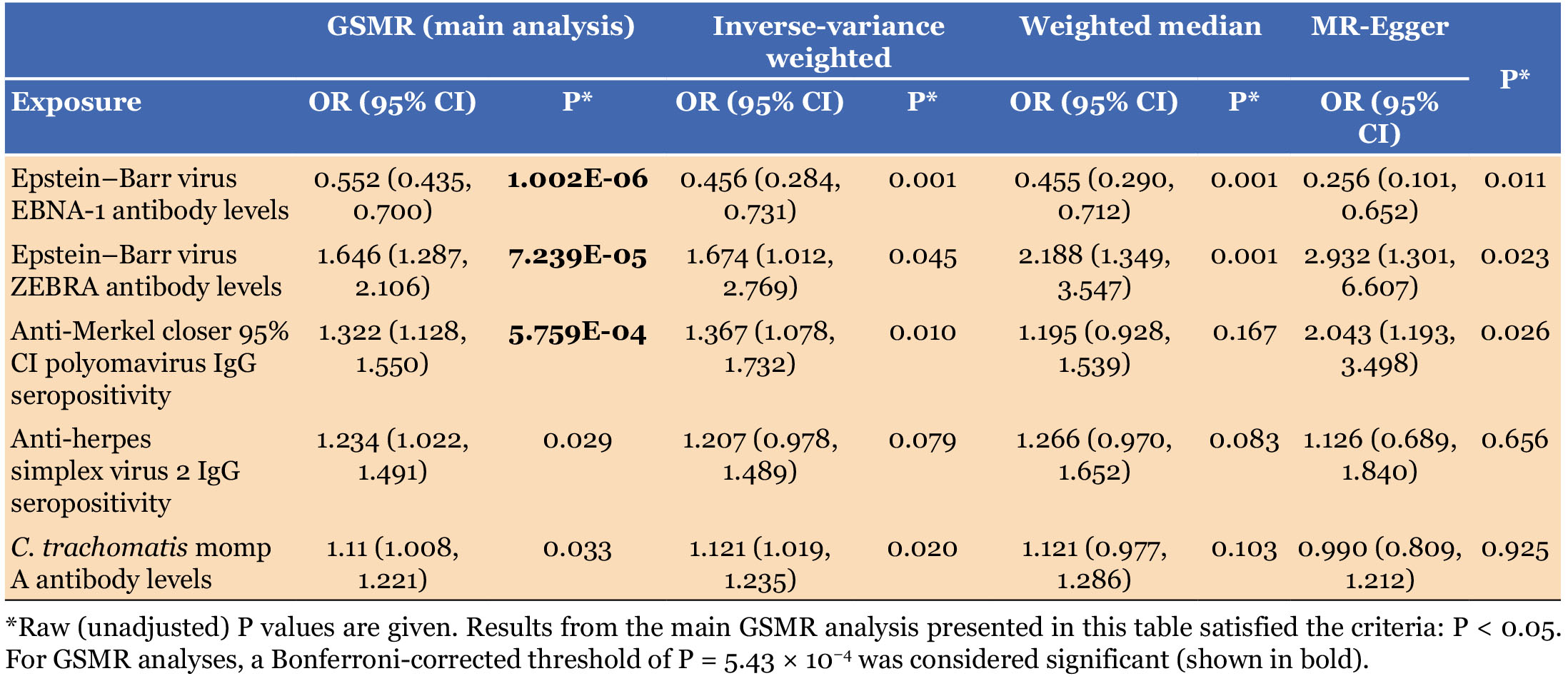
We first investigated the causal impact of infectious agents on PBC using the GSMR method to analyze the relationship between 46 antibodies against infectious agents and PBC. The results revealed that EBV EBNA-1 antibodies had a significant causal effect on reducing PBC risk (OR = 0.552, 95% confidence interval [CI]: 0.435–0.700, P = 1.002 × 10⁻⁶). In addition, EBV ZEBRA antibodies had a significant positive causal effect on PBC (OR = 1.646, 95% CI: 1.287–2.106, P = 7.239 × 10⁻⁵) (Table 1, Figure 1)
Our analyses also demonstrated a positive correlation between genetically elevated anti-Merkel cell polyomavirus IgG seropositivity and PBC (OR = 1.322, 95% CI: 1.128–1.550, P = 5.759 × 10⁻⁴). This association was not statistically significant after Bonferroni correction but showed a low FDR (q-value < 0.05). Similar positive associations were observed between genetically elevated anti-herpes simplex virus 2 immunoglobulin G (IgG) seropositivity and increased PBC risk, as well as between C. trachomatis momp A antibody levels and increased PBC risk (anti-herpes simplex virus 2 IgG: OR = 1.234, 95% CI: 1.022–1.491, P = 0.029; C. trachomatis momp A antibodies: OR = 1.110, 95% CI: 1.008–1.221, P = 0.033) (Table 1, Figure 1). These latter associations were only nominally significant.
The reverse MR analyses of PBC on infectious disease agents
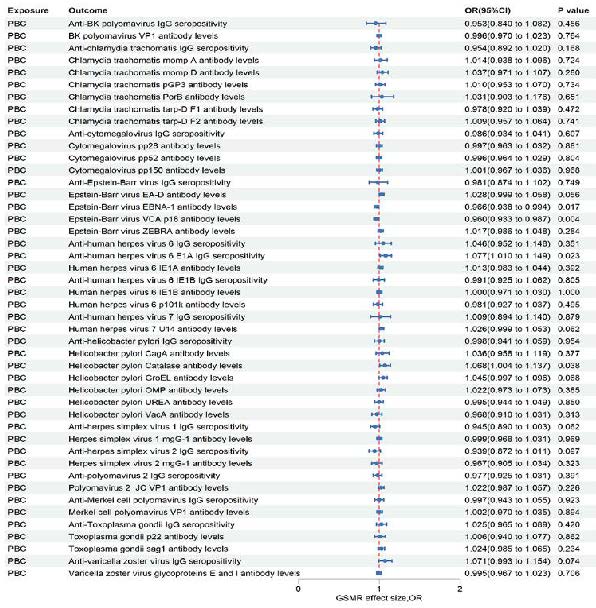
To comprehensively elucidate the complex causal relationships among these traits, we performed reverse MR analyses to explore potential reverse or bidirectional causal associations between infectious agents and PBC. Despite thorough investigation, our results did not demonstrate any statistically significant causal link between PBC and infectious agents at the Bonferroni-corrected significance level.
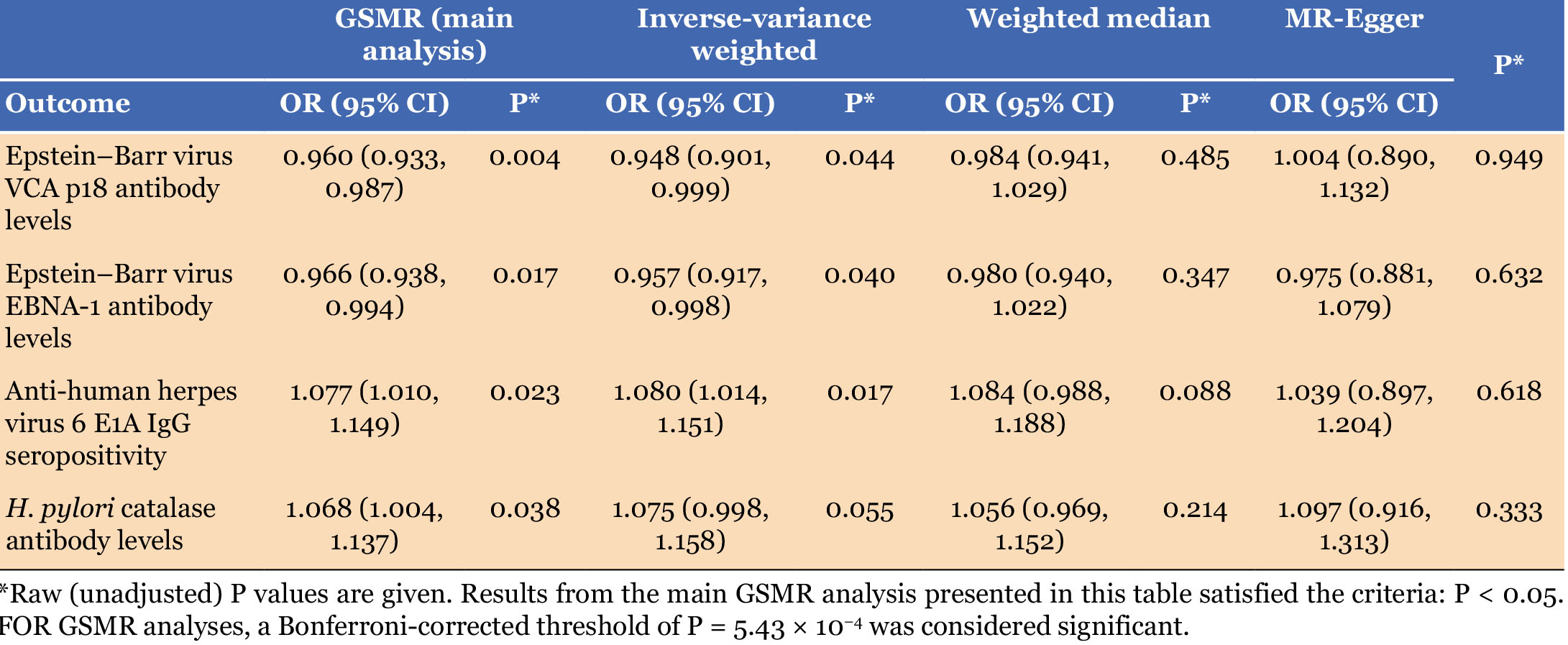
That said, several noteworthy associations were identified in these analyses: PBC was found to correlate with reduced titers of antibodies targeting specific EBV antigens, namely VCA p18 (OR = 0.960, 95% CI: 0.933–0.987, P = 0.004) and EBNA-1 (OR = 0.966, 95% CI: 0.938–0.994, P = 0.017). On the other hand, PBC was associated with elevated seropositivity of IgG antibodies against human herpesvirus 6 E1A (OR = 1.077, 95% CI: 1.010–1.149, P = 0.023), as well as increased levels of antibodies directed against H. pylori catalase (OR = 1.068, 95% CI: 1.004–1.137, P = 0.038). These findings are detailed in Table 2 and illustrated in Figure 2.

Discussion
This MR study set out to investigate the causal connections between pathogen-specific antibody responses and PBC. Our results reveal a multifaceted pattern of associations between these factors, which advances our understanding of PBC pathogenesis and pinpoints key directions for subsequent research. In examining how infectious agents causally influence PBC risk, our analyses identified a range of distinct associations, with the most prominent finding being EBV’s dual role: antibodies targeting EBV EBNA-1 correlated with a reduced PBC risk (OR = 0.55), providing robust evidence for a potential protective effect of this antibody against PBC development; in contrast, EBV ZEBRA antibodies exerted a causal risk-enhancing effect on PBC (OR = 1.65). This contrasting action of EBV in PBC underscores the intricate nature of virus–host crosstalk in driving this disease’s development [20].
Epstein–Barr virus has long been proposed to participate in PBC pathogenesis via mechanisms like molecular mimicry and elevated infection burden, yet conclusive evidence for this link remains lacking. A prior study documented higher EBV DNA prevalence in peripheral blood mononuclear cells, liver tissue, and saliva of PBC patients relative to healthy controls [20], and elevated titers of antibodies against EBV early antigens have also been found in PBC patients. Co-infection with multiple pathogens, including EBV, has additionally been linked to an elevated PBC risk [6]. A recent genomic investigation further indicated that EBV type 2 may play a unique role in PBC through specific interactions with human transcription factors and enrichment at PBC susceptibility loci [21]. Despite these observations, EBV’s high prevalence in the general population poses a major barrier to establishing a definitive causal relationship between this virus and PBC, meaning further research is required to fully delineate EBV’s role in PBC progression.
The inverse association between EBNA-1 antibody levels and PBC risk can be explained by the biological features of latent EBV infection. EBNA-1 is the core protein responsible for maintaining viral episomes during latent infection [22] and contains a unique Gly-Ala repeat domain that actively inhibits its own processing and presentation via the major histocompatibility complex (MHC) class I pathway [23]. This immune evasion mechanism may counterintuitively attenuate the induction of autoimmunity by restricting CD8+ T cell recognition of both viral epitopes and cross-reactive self-epitopes, thereby mitigating the risk of autoimmune damage to biliary epithelial cells.
In contrast, the positive correlation between ZEBRA antibody levels and PBC risk likely reflects the pathological outcomes of lytic EBV reactivation. The ZEBRA protein is a key regulatory factor governing the switch from EBV latent infection to lytic replication [24]; the presence of ZEBRA antibodies in the body may thus indicate that the virus is undergoing or has previously undergone lytic activation. Such viral reactivation triggers a cascade of immune responses and pro-inflammatory mediator release; persistent inflammation arising from this process can damage biliary epithelial cells, disrupt the normal structure and function of bile ducts, and ultimately promote PBC onset and progression. Furthermore, specific structural domains of the ZEBRA protein may share homology with autoantigens expressed on biliary epithelial cells—a classic molecular mimicry effect. During the immune response to the ZEBRA protein, the resulting antibodies may cross-react with homologous self-antigens on biliary epithelial cells, initiating an autoimmune response that elevates PBC risk. This dichotomy aligns with EBV’s well-documented dual role in autoimmunity: latent infection typically fosters immune tolerance, while lytic replication drives inflammatory and autoimmune processes. The dynamic balance between these two viral states may play a pivotal role in modulating PBC susceptibility, with EBNA-1 antibodies serving as a marker of protective latent infection and ZEBRA antibodies indicating pathogenic viral reactivation.
The reverse MR findings, although only nominally significant, offer intriguing insights into the systemic immune dysregulation characteristic of PBC. The observation that PBC may lower EBV VCA p18 and EBNA-1 antibody responses, while potentially increasing responses to HHV-6 and H. pylori, is noteworthy. This differential effect could be attributed to the profound alterations in immune homeostasis seen in PBC patients, including T-cell and B-cell dysfunction, and the potential use of immunosuppressive therapies. These factors could variably influence the host’s ability to mount and maintain antibody responses against different pathogens. Alternatively, the observed changes in antibody levels might be a consequence of the disease process itself, rather than a driver. These findings are preliminary and warrant further investigation.
A key strength of this study is its adoption of the MR approach, a robust tool for inferring causal relationships between exposures and outcomes. By using genetic variants as instrumental variables, we minimized the confounding effects and reverse causality biases that commonly compromise the validity of traditional observational studies. Additionally, the combined application of multiple MR analytical methods (GSMR, IVW, weighted median, and MR-Egger) and comprehensive sensitivity analyses further reinforces the reliability of our findings.
This study, however, has several inherent limitations. First, while genetic instrumental variables were selected using stringent criteria, residual confounding or bias may still exist due to the intrinsic imperfections of instrumental variables in MR research. Second, while our sensitivity analyses did not detect significant horizontal pleiotropy, these tests have limited statistical power. Thus, the possibility of residual horizontal pleiotropy affecting our results cannot be entirely excluded. Third, the MR approach estimates the average linear effect of the exposure on the outcome and does not account for potential non-linear effects or gene–environment interactions, which could modify the observed associations. Fourth, the antibody GWAS data used (e.g., for HSV-2) may be subject to selection bias, as they are often derived from seropositive populations. This could introduce collider bias if both the exposure and outcome influence the probability of being included in the study. Fifth, the study cohort was limited to individuals of European ancestry, which may restrict the generalizability of our results to other ethnic and racial groups. Sixth, while MR analysis provides compelling evidence for causal associations, it does not elucidate the underlying molecular and cellular mechanisms. As such, further experimental research is needed to unravel how these infectious pathogens and the host’s corresponding immune responses modulate PBC development.
Conclusion
This MR study clarifies the causal links between infectious pathogen-specific antibodies and PBC, uncovering complex pathogen-driven effects on PBC risk. Epstein–Barr virus exerts opposing roles: EBNA-1 antibodies are protective against PBC, while ZEBRA antibodies increase disease risk. Suggestive associations were also found for Merkel cell polyomavirus, herpes simplex virus 2, and C. trachomatis also contribute to PBC development, highlighting the intricate host–pathogen interactions underlying PBC pathogenesis that warrant further investigation.
Subsequent research should further validate these associations, elucidate the biological mechanisms by which infectious pathogens regulate PBC onset and progression, and explore targeted preventive and therapeutic strategies for the disease. Replication studies in ethnically diverse populations are also needed to confirm the generalizability of these findings and clarify the global role of infectious agents in PBC burden.
REFERENCES
1.
Ashraf T, Abunada O, Seerani N, Ali K, Muhammad A, Mir SL, et al. The role of Seladelpar in primary biliary cholangitis: A systematic review and meta-analysis. BMC Gastroenterol 2025;25(1):224. [CrossRef]
[Pubmed]

2.
Rigopoulou EI, Bogdanos DP. Role of autoantibodies in the clinical management of primary biliary cholangitis. World J Gastroenterol 2023;29(12):1795–810. [CrossRef]
[Pubmed]
3.
Zhang HP, Zhou Z, Chen K, Xiong LF, Wu J, Jin L. Primary biliary cholangitis has causal effects on systemic rheumatic diseases: A Mendelian randomization study. BMC Gastroenterol 2024;24(1):294. [CrossRef]
[Pubmed]
4.
Sundaresan B, Shirafkan F, Ripperger K, Rattay K. The role of viral infections in the onset of autoimmune diseases. Viruses 2023;15(3):782. [CrossRef]
[Pubmed]
5.
Nielsen PR, Kragstrup TW, Deleuran BW, Benros ME. Infections as risk factor for autoimmune diseases – A nationwide study. J Autoimmun 2016;74:176–81. [CrossRef]
[Pubmed]
6.
Shapira Y, Agmon-Levin N, Renaudineau Y, Porat-Katz BS, Barzilai O, Ram M, et al. Serum markers of infections in patients with primary biliary cirrhosis: Evidence of infection burden. Exp Mol Pathol 2012;93(3):386–90. [CrossRef]
[Pubmed]
7.
Selmi C, De Santis M, Cavaciocchi F, Gershwin ME. Infectious agents and xenobiotics in the etiology of primary biliary cirrhosis. Dis Markers 2010;29(6):287–99. [CrossRef]
[Pubmed]
8.
Kita H. Primary biliary cirrhosis and E. coli-induced pyelonephritis; are infectious agents related to the pathogenesis of primary biliary cirrhosis? Intern Med 2003;42(11):1063–4. [CrossRef]
[Pubmed]
9.
Smyk DS, Rigopoulou EI, Bogdanos DP. Potential roles for infectious agents in the pathophysiology of primary biliary cirrhosis: What’s new? Curr Infect Dis Rep 2013;15(1):14–24. [CrossRef]
[Pubmed]
10.
Sanderson E, Glymour MM, Holmes MV, Kang H, Morrison J, Munafò MR, et al. Mendelian randomization. Nat Rev Methods Primers 2022;2:6. [CrossRef]
[Pubmed]
11.
Cui Y, Guo Y, Kong Y, Zhang G. Association between gut microbiota and autoimmune cholestatic liver disease, a Mendelian randomization study. Front Microbiol 2024;15:1348027. [CrossRef]
[Pubmed]
12.
Ge F, Huo Z, Wang R, Huang Q. Genetic liability for insomnia and asthma risk. Clin Respir J 2022;16(2):167–9. [CrossRef]
[Pubmed]
13.
Skrivankova VW, Richmond RC, Woolf BAR, Yarmolinsky J, Davies NM, Swanson SA, et al. Strengthening the reporting of observational studies in epidemiology using Mendelian randomization: The STROBE-MR statement. JAMA 2021;326(16):1614–21. [CrossRef]
[Pubmed]
14.
Nguyen K, Mitchell BD. A guide to understanding Mendelian randomization studies. Arthritis Care Res (Hoboken) 2024;76(11):1451–60. [CrossRef]
[Pubmed]
15.
Butler-Laporte G, Kreuzer D, Nakanishi T, Harroud A, Forgetta V, Richards JB. Genetic determinants of antibody-mediated immune responses to infectious diseases agents: A genome-wide and HLA association study. Open Forum Infect Dis 2020;7(11):ofaa450. [CrossRef]
[Pubmed]
16.
Kurki MI, Karjalainen J, Palta P, Sipilä TP, Kristiansson K, Donner KM, et al. FinnGen provides genetic insights from a well-phenotyped isolated population. Nature 2023;613(7944):508–18. [CrossRef]
[Pubmed]
17.
Chiariglione M, Arch AJ, Gao XR. Whole-exome sequencing identifies rare variants and genes associated with glaucoma. Invest Ophthalmol Vis Sci 2023;64(8):100–10.
18.
Qiao TC, Tian HY, Shan SZ, Shan LL, Peng ZY, Ke J, et al. Causal relationship between inflammatory factors and cerebral small vessel disease: Univariate, multivariate, and summary-data-based mendelian randomization analysis. Brain Behav 2024;14(2):e3399. [CrossRef]
[Pubmed]
19.
Xue A, Zhu Z, Wang H, Jiang L, Visscher PM, Zeng J, et al. Unravelling the complex causal effects of substance use behaviours on common diseases. Commun Med (Lond) 2024;4(1):43. [CrossRef]
[Pubmed]
20.
Rigopoulou EI, Smyk DS, Matthews CE, Billinis C, Burroughs AK, Lenzi M, et al. Epstein-Barr virus as a trigger of autoimmune liver diseases. Adv Virol 2012;2012:987471. [CrossRef]
[Pubmed]
21.
Viel KCMF, Parameswaran S, Donmez OA, Forney CR, Hass MR, Yin C, et al. Shared and distinct interactions of type 1 and type 2 Epstein-Barr nuclear antigen 2 with the human genome. BMC Genomics 2024;25(1):273. [CrossRef]
[Pubmed]
22.
Sugden B, Warren N. A promoter of Epstein-Barr virus that can function during latent infection can be transactivated by EBNA-1, a viral protein required for viral DNA replication during latent infection. J Virol 1989;63(6):2644–9. [CrossRef]
[Pubmed]
23.
Levitskaya J, Sharipo A, Leonchiks A, Ciechanover A, Masucci MG. Inhibition of ubiquitin/proteasome-dependent protein degradation by the Gly-Ala repeat domain of the Epstein-Barr virus nuclear antigen 1. Proc Natl Acad Sci U S A 1997;94(23):12616–21. [CrossRef]
[Pubmed]
24.
El-Guindy AS, Miller G. Phosphorylation of Epstein-Barr virus ZEBRA protein at its casein kinase 2 sites mediates its ability to repress activation of a viral lytic cycle late gene by Rta. J Virol 2004;78(14):7634–44. [CrossRef]
[Pubmed]
SUPPORTING INFORMATION
Acknowledgments
We express our gratitude to UK Biobank and FinnGen biobank for publicly sharing their datasets, and we sincerely thank all the researchers and participants involved in these studies. This study was supported by Natural Science Youth Project of Bengbu Medical University (No. 2024byzd085) and the 2024 Science and Technology Innovation Guidance Program of Bengbu City (No.18).
Artificial intelligence (AI) use in the article:
• No generative AI technology was used in the preparation of this manuscript, and no AI tool is listed as a co-author.
• No content generated by AI was included in any section of the article.
Yunchuan Yang † - Conception of the work, Design of the work, Revising the work critically for important intellectual content, Final approval of the version to be published, Agree to be accountable for all aspects of the work in ensuring that questions related to the accuracy or integrity of any part of the work are appropriately investigated and resolved.
Zhengxin Zhao † - Conception of the work, Design of the work, Acquisition of data, Analysis of data, Drafting the work, Revising the work critically for important intellectual content, Final approval of the version to be published, Agree to be accountable for all aspects of the work in ensuring that questions related to the accuracy or integrity of any part of the work are appropriately investigated and resolved.
Junyi Huo - Conception of the work, Design of the work, Acquisition of data, Analysis of data, Drafting the work, Revising the work critically for important intellectual content, Final approval of the version to be published, Agree to be accountable for all aspects of the work in ensuring that questions related to the accuracy or integrity of any part of the work are appropriately investigated and resolved.
Ke Guo - Revising the work critically for important intellectual content, Final approval of the version to be published, Agree to be accountable for all aspects of the work in ensuring that questions related to the accuracy or integrity of any part of the work are appropriately investigated and resolved.
Lei Zhou - Revising the work critically for important intellectual content, Final approval of the version to be published, Agree to be accountable for all aspects of the work in ensuring that questions related to the accuracy or integrity of any part of the work are appropriately investigated and resolved.
Guarantor of SubmissionThe corresponding author is the guarantor of submission.
Source of SupportNone
Consent StatementWritten informed consent was obtained from the patient for publication of this article.
Data AvailabilityAll relevant data are within the paper and its Supporting Information files.
Conflict of InterestAuthors declare no conflict of interest.
Copyright© 2026 Yunchuan Yang et al. This article is distributed under the terms of Creative Commons Attribution License which permits unrestricted use, distribution and reproduction in any medium provided the original author(s) and original publisher are properly credited. Please see the copyright policy on the journal website for more information.